Book highlights: “On Writing Well” by William Zinsser
LM → my comments
One of the pictures hanging in my office in mid-Manhattan is a photograph of the writer E. B. White.
LM: his most famous book being “Charlotte’s Web”.
That condition was first revealed with the arrival of the word processor. Two opposite things happened: good writers got better and bad writers got worse. Good writers welcomed the gift of being able to fuss endlessly with their sentences—pruning and revising and reshaping—without the drudgery of retyping. Bad writers became even more verbose because writing was suddenly so easy and their sentences looked so pretty on the screen. How could such beautiful sentences not be perfect?
LM: It’s funny to see history repeating itself again with AI. For context, this book was first published in 1976.
On Writing Well is a craft book, and its principles haven’t changed since it was written 30 years ago. I don’t know what still newer marvels will make writing twice as easy in the next 30 years. But I do know they won’t make writing twice as good. That will still require plain old hard thinking—what E. B. White was doing in his boathouse—and the plain old tools of the English language.
Ultimately the product that any writer has to sell is not the subject being written about, but who he or she is. … What holds me is the enthusiasm of the writer for his field. How was he drawn into it? What emotional baggage did he bring along? How did it change his life?
LM: it’s not about the thing, it’s about the story behind the thing.
the secret of good writing is to strip every sentence to its cleanest components. Every word that serves no function, every long word that could be a short word, every adverb that carries the same meaning that’s already in the verb, every passive construction that leaves the reader unsure of who is doing what—these are the thousand and one adulterants that weaken the strength of a sentence. And they usually occur in proportion to education and rank.
Writers must therefore constantly ask: what am I trying to say? Surprisingly often they don’t know. Then they must look at what they have written and ask: have I said it?
“Experiencing” is one of the worst clutterers. Even your dentist will ask if you are experiencing any pain. If he had his own kid in the chair he would say, “Does it hurt?” He would, in short, be himself.
As George Orwell pointed out in “Politics and the English Language,” an essay written in 1946 but often cited during the wars in Cambodia, Vietnam and Iraq, “political speech and writing are largely the defense of the indefensible… Thus political language has to consist largely of euphemism, question-begging and sheer cloudy vagueness.” Orwell’s warning that clutter is not just a nuisance but a deadly tool has come true in the recent decades of American military adventurism.
LM: Politics and the English Language. From this essay:
i. Never use a metaphor, simile or other figure of speech which you are used to seeing in print.
ii. Never use a long word where a short one will do.
iii. If it is possible to cut a word out, always cut it out.
iv. Never use the passive where you can use the active.
v. Never use a foreign phrase, a scientific word or a jargon word if you can think of an everyday English equivalent.
vi. Break any of these rules sooner than say anything outright barbarous.
Beware, then, of the long word that’s no better than the short word: “assistance” (help), “numerous” (many), “facilitate” (ease), “individual” (man or woman), “remainder” (rest), “initial” (first), “implement” (do), “sufficient” (enough), “attempt” (try), “referred to as” (called) and hundreds more.
which brings me back to the problem of trying to relax. Assume that you are the writer sitting down to write. You think your article must be of a certain length or it won’t seem important. You think how august it will look in print. You think of all the people who will read it. You think that it must have the solid weight of authority. You think that its style must dazzle. No wonder you tighten; you are so busy thinking of your awesome responsibility to the finished article that you can’t even start.
Writers are obviously at their most natural when they write in the first person. Writing is an intimate transaction between two people, conducted on paper, and it will go well to the extent that it retains its humanity.
Leaders who bob and weave like aging boxers don’t inspire confidence—or deserve it. The same thing is true of writers. Sell yourself, and your subject will exert its own appeal. Believe in your own identity and your own opinions. Writing is an act of ego, and you might as well admit it. Use its energy to keep yourself going.
when you’re choosing words and stringing them together, how they sound. This may seem absurd: readers read with their eyes. But in fact they hear what they are reading far more than you realize. Therefore such matters as rhythm and alliteration are vital to every sentence.
I don’t want to give somebody my input and get his feedback, though I’d be glad to offer my ideas and hear what he thinks of them. Good usage, to me, consists of using good words if they already exist—as they almost always do—to express myself clearly and simply to someone else.
You learn to write by writing. It’s a truism, but what makes it a truism is that it’s true. The only way to learn to write is to force yourself to produce a certain number of words on a regular basis.
All writing is ultimately a question of solving a problem. It may be a problem of where to obtain the facts or how to organize the material. It may be a problem of approach or attitude, tone or style. Whatever it is, it has to be confronted and solved.
LM: pragmatic and rational approach to writing
Therefore ask yourself some basic questions before you start. For example: “In what capacity am I going to address the reader?” (Reporter? Provider of information? Average man or woman?) “What pronoun and tense am I going to use?” “What style?” (Impersonal reportorial? Personal but formal? Personal and casual?) “What attitude am I going to take toward the material?” (Involved? Detached? Judgmental? Ironic? Amused?) “How much do I want to cover?” “What one point do I want to make?”
One moral of this story is that you should always collect more material than you will use. Every article is strong in proportion to the surplus of details from which you can choose the few that will serve you best…
Another approach is to just tell a story. It’s such a simple solution, so obvious and unsophisticated, that we often forget that it’s available to us. But narrative is the oldest and most compelling method of holding someone’s attention; everybody wants to be told a story. Always look for ways to convey your information in narrative form.
Most adverbs are unnecessary. You will clutter your sentence and annoy the reader if you choose a verb that has a specific meaning and then add an adverb that carries the same meaning. Don’t tell us that the radio blared loudly; “blare” connotes loudness. Don’t write that someone clenched his teeth tightly;
Prune out the small words that qualify how you feel and how you think and what you saw: “a bit,” “a little,” “sort of,” “kind of,” “rather,” “quite,” “very,” “too,” “pretty much,” “in a sense” and dozens more. They dilute your style and your persuasiveness.
Don’t say you weren’t too happy because the hotel was pretty expensive. Say you weren’t happy because the hotel was expensive. Don’t tell us you were quite fortunate. How fortunate is that? Don’t describe an event as rather spectacular or very awesome. Words like “spectacular” and “awesome” don’t submit to measurement. “Very” is a useful word to achieve emphasis, but far more often it’s clutter. There’s no need to call someone very methodical. Either he is methodical or he isn’t.
This is a new American disease that strings two or three nouns together where one noun—or, better yet, one verb—will do. Nobody goes broke now; we have money problem areas. It no longer rains; we have precipitation activity or a thunderstorm probability situation. Please, let it rain.
Don’t overstate. You didn’t really consider jumping out the window. Life has more than enough truly horrible funny situations. Let the humor sneak up so we hardly hear it coming.
THE QUICKEST FIX. Surprisingly often a difficult problem in a sentence can be solved by simply getting rid of it.
Keep your paragraphs short. Writing is visual—it catches the eye before it has a chance to catch the brain. Short paragraphs put air around what you write and make it look inviting, whereas a long chunk of type can discourage a reader from even starting to read.
Where a certain occupation has both a masculine and a feminine form, look for a generic substitute. Actors and actresses can become performers.
Instead of talking about what “the writer” does and the trouble he gets into, I found more places where I could address the writer directly (“You’ll often find …”). It doesn’t work for every kind of writing, but it’s a godsend to anyone writing an instructional book or a self-help book.
When you read your writing aloud with these connecting links in mind you’ll hear a dismaying number of places where you lost the reader, or confused the reader, or failed to tell him the one fact he needed to know, or told him the same thing twice: the inevitable loose ends of every early draft. What you must do is make an arrangement—one that holds together from start to finish and that moves with economy and warmth. Learn to enjoy this tidying process. I don’t like to write; I like to have written. But I love to rewrite.
Ending
if you’re going to write good nonfiction you must wriggle out of III’s dread grip. You’ll know you have arrived at III when you see emerging on your screen a sentence that begins, “In sum, it can be noted that …” Or a question that asks, “What insights, then, have we been able to glean from …?” These are signals that you are about to repeat in compressed form what you have already said in detail. The reader’s interest begins to falter; the tension you have built begins to sag. Yet you will be true to Miss Potter, your teacher, who made you swear fealty to the holy outline. You remind the reader of what can, in sum, be noted. You go gleaning one more time in insights you have already adduced.
LM: from old school composition teachers: every story must have a beginning (I), a middle(IIa nd IIb) and an end(III).
That’s the negative reason for remembering the importance of the last sentence. Failure to know where that sentence should occur can wreck an article that until its final stage has been tightly constructed. The positive reason for ending well is that a good last sentence—or last paragraph—is a joy in itself. It gives the reader a lift, and it lingers when the article is over.
The perfect ending should take your readers slightly by surprise and yet seem exactly right. They didn’t expect the article to end so soon, or so abruptly, or to say what it said. But they know it when they see it. Like a good lead, it works.
For the nonfiction writer, the simplest way of putting this into a rule is: when you’re ready to stop, stop. If you have presented all the facts and made the point you want to make, look for the nearest exit. Often it takes just a few sentences to wrap things up. Ideally they should encapsulate the idea of the piece and conclude with a sentence that jolts us with its fitness or unexpectedness.
what usually works best is a quotation. Go back through your notes to find some remark that has a sense of finality, or that’s funny, or that adds an unexpected closing detail.
Capture the reader’s attention
The most important sentence in any article is the first one. If it doesn’t induce the reader to proceed to the second sentence, your article is dead. And if the second sentence doesn’t induce him to continue to the third sentence, it’s equally dead. Of such a progression of sentences, each tugging the reader forward until he is hooked, a writer constructs that fateful unit, the “lead”.
Therefore your lead must capture the reader immediately and force him to keep reading. It must cajole him with freshness, or novelty, or paradox, or humor, or surprise, or with an unusual idea, or an interesting fact, or a question. Anything will do, as long as it nudges his curiosity and tugs at his sleeve. Next the lead must do some real work. It must provide hard details that tell the reader why the piece was written and why he ought to read it.
LM: lead = capture the reader + tell him the why
”That” vs “Which”
Always use “that” unless it makes your meaning ambiguous. Notice that in carefully edited magazines, such as The New Yorker, “that” is by far the predominant usage. I mention this because it is still widely believed—a residue from school and college—that “which” is more correct, more acceptable, more literary. It’s not. In most situations, “that” is what you would naturally say and therefore what you should write.
If your sentence needs a comma to achieve its precise meaning, it probably needs “which.” “Which” serves a particular identifying function, different from “that.” (A) “Take the shoes that are in the closet.” This means: take the shoes that are in the closet, not the ones under the bed. (B) “Take the shoes, which are in the closet.” Only one pair of shoes is under discussion; the “which” usage tells you where they are. Note that the comma is necessary in B, but not in A.
Travel writing
Nobody turns so quickly into a bore as a traveler home from his travels. He enjoyed his trip so much that he wants to tell us all about it—and “all” is what we don’t want to hear. We only want to hear some. What made his trip different from everybody else’s? What can he tell us that we don’t already know? We don’t want him to describe every ride at Disneyland, or tell us that the Grand Canyon is awesome, or that Venice has canals. If one of the rides at Disneyland got stuck, if somebody fell into the awesome Grand Canyon, that would be worth hearing about.
What McPhee has done is to capture the idea of Juneau and Anchorage. Your main task as a travel writer is to find the central idea of the place you’re dealing with.
But whatever place you write about, go there often enough to isolate the qualities that make it distinctive. Usually this will be some combination of the place and the people who inhabit it.
LM: “Coming Into the Country” by John McPhee, an account of Alaska and the Alaskans
Humor
Also resist using an exclamation point to notify the reader that you are making a joke or being ironic. “It never occurred to me that the water pistol might be loaded!” Readers are annoyed by your reminder that this was a comical moment. They are also robbed of the pleasure of finding it funny on their own. Humor is best achieved by understatement, and there’s nothing subtle about an exclamation point.
“Should I refer to you as a humorist? Or have you also written anything serious?” The answer is that if you’re trying to write humor, almost everything you do is serious.
One Catch–22 or Dr. Strangelove is more powerful than all the books and movies that try to show war “as it is.” Those two works of comic invention are still standard points of reference for anyone trying to warn us about the military mentality that could blow us all up tomorrow.
Don’t search for the outlandish and scorn what seems too ordinary; you will touch more chords by finding what’s funny in what you know to be true. Finally, don’t strain for laughs; humor is built on surprise, and you can surprise the reader only so often.
Main takeaways
- it’s not about the thing, it’s about the story behind the thing (your story, your WHY, your views)
- strip every sentence to its cleanest components
- ”What am I trying to say?” -> write -> “Have I said it?“
- prefer the simple and short words
- write in first person
- listen to how your writing sounds (rhythm and alliteration)
- the most important sentence is the first one, then the second, then the third. This is the lead, and should capture the reader.
- prefer the narrative style when possible (most compelling method of holding someone’s attention; everybody wants to be told a story)
- if you have presented all the facts and made the point you want to make, look for the nearest exit. stop. (a quotation that has sense of finality, or that’s funny, or that adds an unexpected closing detail works well here)
- most adverbs are unnecessary (adverbs that carry the same meaning as the verb)
- prune: “a bit”, “a little”, “sort of”, “kind of”, “rather”, “quite”, “very”, “too”, “pretty much”
- prefer to use “that” (instead of “which”)
- humor is best achieved by understatement. Don’t overstate.
- prefer short paragraphs
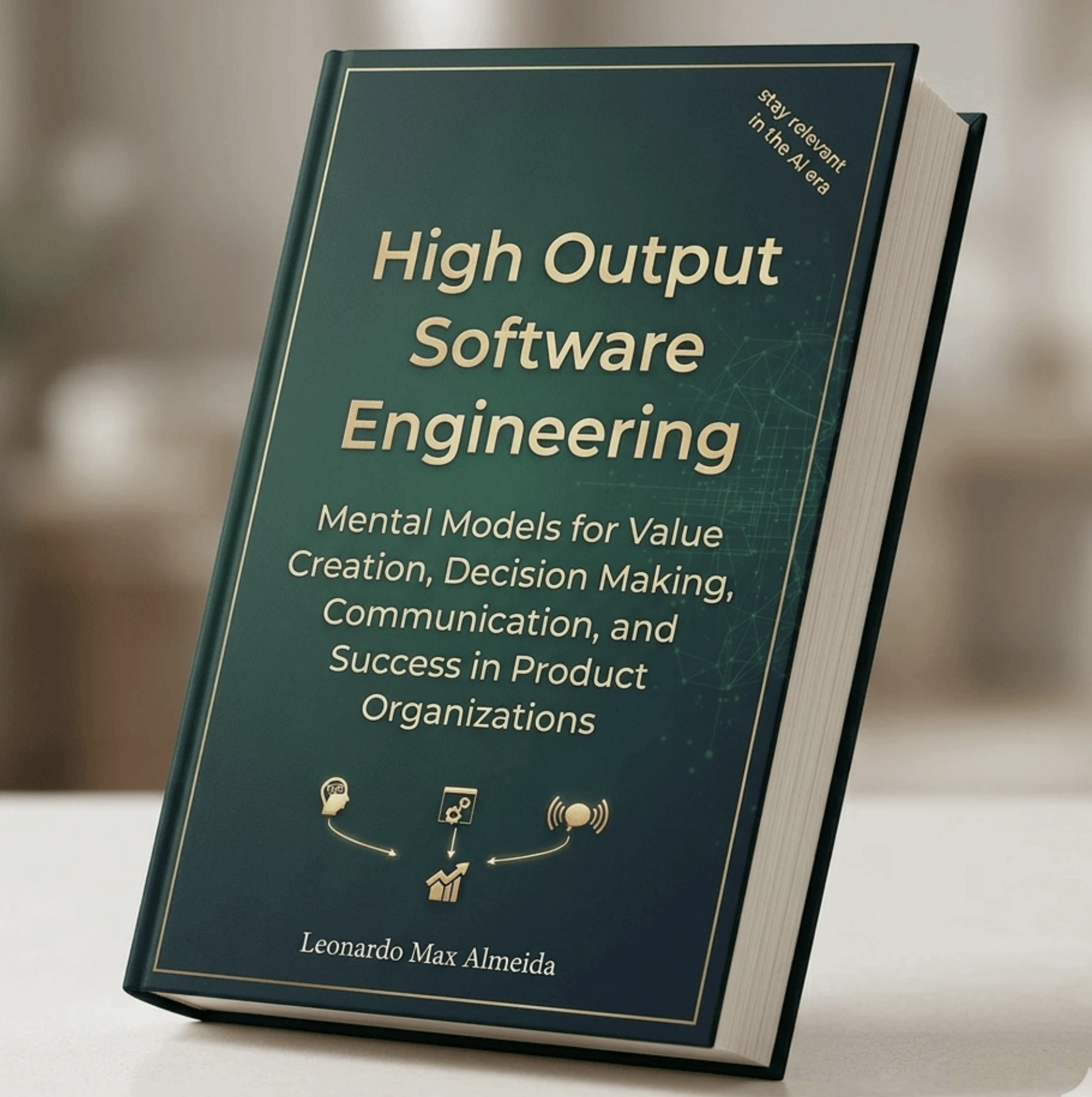
If you're a software engineer working on product teams you might enjoy my book High Output Software Engineering — it's all about understanding value creation, making value-driven trade-offs, communicating with excellence and knowing how to navigate organization dynamics.
Buy it now for $0.99 (PDF & EPUB instant access)