Book Sample: Chapter 1 - Why, What, Who, How
your-code-is-not-the-most-important-thing Product and Tech book-sample
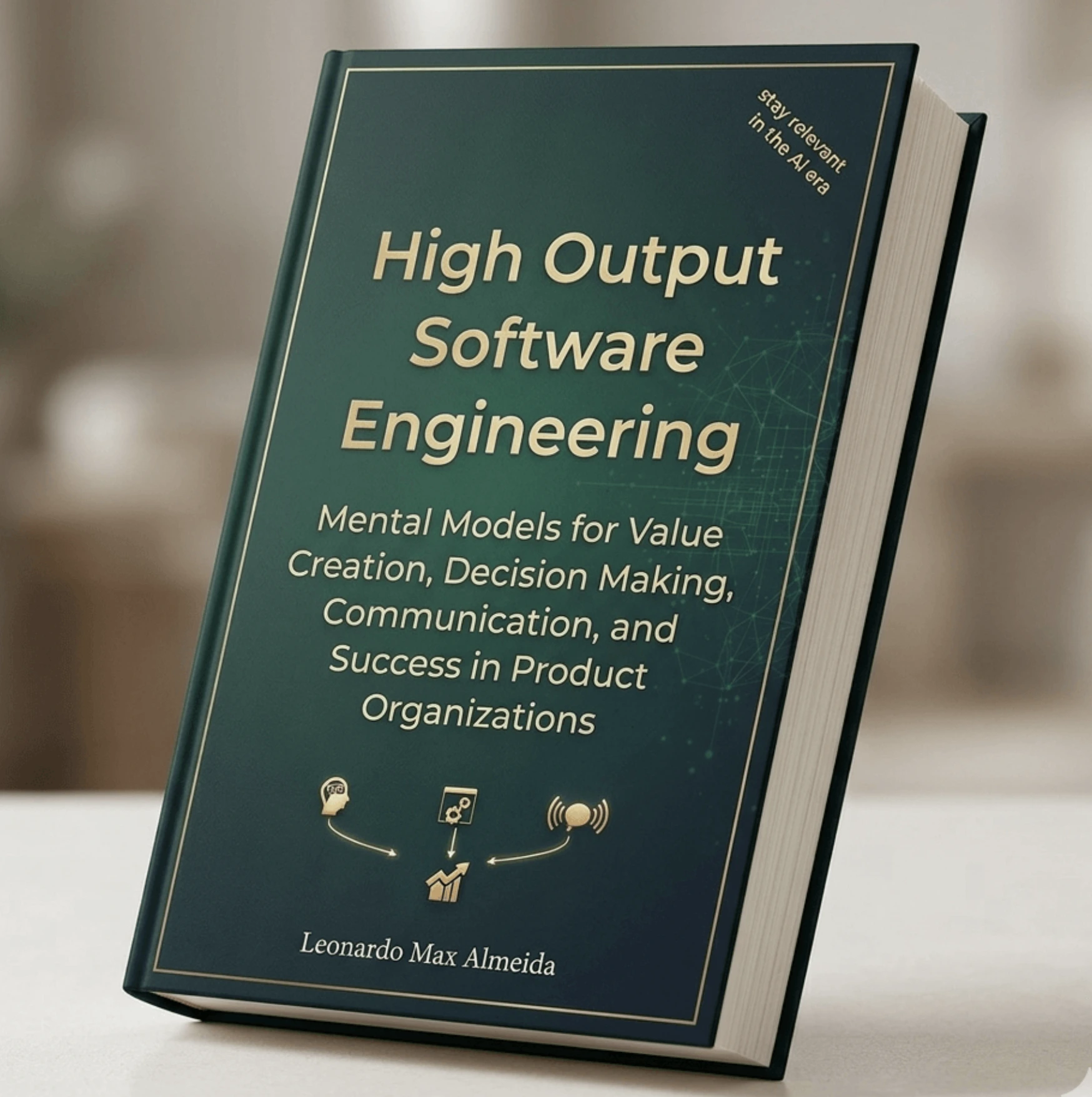
This is the first chapter of High Output Software Engineering.
---
Why read this book?
Most software engineers have never been exposed to a really strong product culture with great leaders or mentors and therefore have not yet developed a business-oriented view of value creation, focusing only on improving technical skills and maybe not paying as much attention to other aspects that are equally important: value-driven decision-making, communication, and learning how to navigate organizational dynamics.
This book aims to be that guiding mentor to teach you the most important mental models and behaviors of a value-focused software engineer working on a product team. No matter where you are in this journey right now, I bet you will find something useful that you can start applying today.
If you’re still not convinced that becoming a value-focused engineer is worth your time right now, let me share a couple of quotes from the interviews I did with CEOs, CTOs, engineering managers, and tech leads during the research for this book.
This is what they told me when I asked them “What are the most important challenges you’re currently experiencing with your team?”:
- “People don’t understand what actually delivers value for the company; they think code is the most important thing in the world."
- "The team doesn’t really have a sense of usefulness. They do things just for the sake of doing them, without thinking about the trade-offs of what will actually generate more value. They write code for code’s sake."
- "They made a more complex implementation than they should have, which took more time."
- "This is my biggest challenge here, how to change this mindset of only thinking about the behavior we want to deliver and expand it to how this feature can work better."
- "There’s a really good guy who, whenever someone asks for something, he just goes and builds it — but, like, no, it’s a random project, a proof of concept, we don’t even know if it’s going to production.”
Regardless of whether these leaders are objectively ‘right,’ this is what is in their mental space at the moment, and whether you like it or not, these are the people that can heavily influence, help and accelerate you towards your goals. It’s essential that your definition of value creation be aligned with their definition, and as you saw above, there is currently an unfortunate disconnect.
Also, with artificial intelligence (AI) getting better and better at producing high-quality and maintainable code, the purely technical engineers who focus on delivering only Jira tickets will be left behind. Value-focused software engineers will be needed for much, much longer.
What this book is, what it isn’t, and who it is for
This book will guide you on the path to becoming a Value-Focused Software Engineer by teaching you what value creation really means and, based on that definition, sharing the behaviors and mental models that you should incorporate or emulate.
The result? A day-to-day work life with less stress, more clarity, and more intention, for you and for the people around you. A career that progresses at the speed and direction you want.
Note that we won’t talk directly about technology stacks or architecture frameworks. Those topics are important, but there is already amazing content about it out there (The Appendix section has some of my recommendations). I’ll use examples and share stories citing technologies I interacted with, but that’s just what they are: examples based on my personal experiences. You should be able to map those examples to the technologies you are most familiar with.
Speaking of those examples, I wrote this book specifically for software engineers working on product teams. Other kinds of engineers (data, machine learning, platform, QA, security, highly specialized/low-level engineers, etc.) or roles inside a tech organization (Product, Finance, HR) might still get a lot of value from this book but the examples won’t be as relatable, which may make the reading experience less optimal. Just a friendly warning if you are not a software engineer working on a product team. 😉
But you might be asking, “Why should I listen to you?”
Why I’m a relevant source of advice
I’ve achieved some pretty cool things in my career using the mental models and behaviors I’m about to teach you in this book:
- CTO at a leading mobile ad network, handling 5B requests/month and managing a team of 20 incredible engineers (back in the day, we were one of the five most installed SDKs for the Android ecosystem, according to a post from TechCrunch)
- Built a 5-star Upwork profile with only amazing reviews
- ”Wow, Leonardo is the best developer I have worked with hands down! He beat the deadline and understood exactly what needed to be done. I would love to work with Leonardo again and again!”
- Subject Matter Expert for systems generating $100M+/year in incremental revenue for the pharmaceutical industry
All of that having only worked professionally with JavaScript as a programming language (and later TypeScript) and MongoDB as a database (I learned Postgres after being accepted for my last job). In my experience, focusing on value creation has always paid off when compared to learning a new programming language or a new framework that I didn’t really have a business need for.
I’m really happy with my career so far (isn’t it the end goal, anyway?). I lived a work life full of learnings and interesting challenges, which, in the more recent years, allowed me to experience way less stress than what’s common in our profession (stress usually associated with production bugs, deadlines and miscommunication problems). I’m also pretty happy with the relationships I’ve built along the way, having made way more friends than enemies.
How this book works
In the next chapter, Defining value as a software engineer, we will set up the foundation on which the rest of the book is built. This is what we will do:
- define value as helping people save time and reduce stress
- define value in the context of your job at a company as helping the customer save time and reduce stress
- explain that value to the customer can be created in two ways: directly through product features, and indirectly through better decision-making and facilitating internal communication, which is what this book is about.
- learn that there are mental models for making better decisions and facilitating internal communication and that business context always has to be the main input for those mental models.
- explain why excellent communication creates so much indirect value
- start seeing code as technical debt to help shift our focus away from code and architecture and more towards value creation.
With this foundation in place guiding the journey, we will move to learning how to actually think and behave like a Value-Focused Software Engineer. We will learn how to automate decision-making, how to prioritize our work, how to communicate with excellence and how to think about the other people and teams inside our organization. Those different aspects are divided into the following three chapters for easy reference later on:
- Mental models for decision-making and prioritization
- Become an excellent communicator
- Mental models for navigating people & organization dynamics
The last main content chapter, Value for you - Increasing your efficiency, effectiveness, and converting the value you create into future opportunities, will cover topics that will help you directly. You will learn strategies for feeling productive each day, for maintaining the quality of your deliverables and for optimizing your path to mastery in the Software Engineering journey. Most importantly, you will learn how to use the value you are creating now as leverage for yourself in the future, maximizing your chances of getting your dream job or opportunity.
I hope you have a couple of a-ha moments during the next pages. Let’s get started!
---
This is the first chapter of High Output Software Engineering. Read another sample on The hidden costs of additions to a system.
If you're a software engineer working on product teams and found this useful, you might enjoy my book High Output Software Engineering — it's all about understanding value creation, making value-driven trade-offs, communicating with excellence and knowing how to navigate organization dynamics.
Learn more on the book page